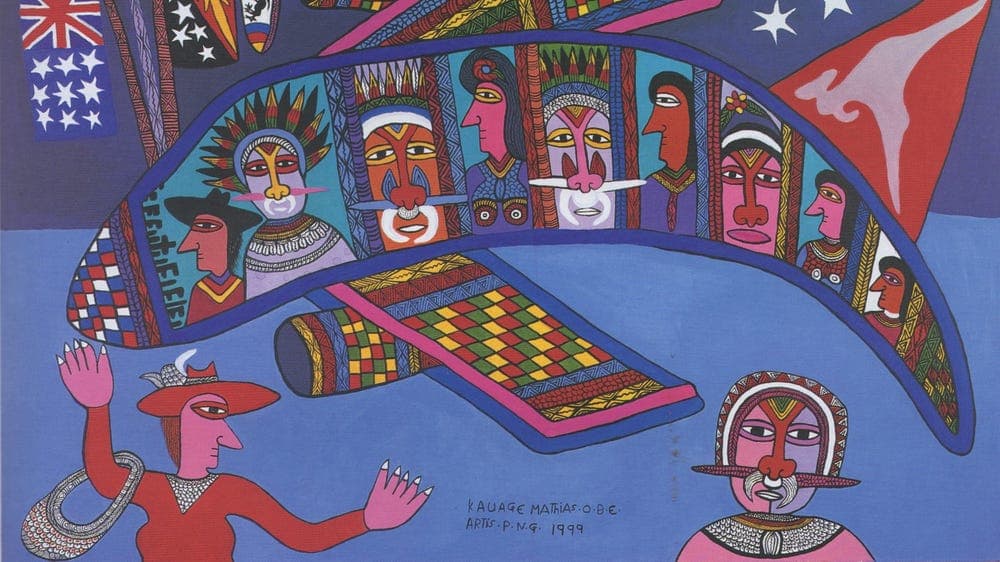
Mathias Kauage (Mingu Village, Kundiawa-Gembogl District, Chimbu [Simbu] Province, now in the independent country of Papua New Guinea, ca. 1944–2003). Kauage Flies to Scotland for Opening of New Museum of Contemporary Art (detail), 1999. Acrylic on canvas, 47 1/4 x 72 1/16 in. (120 x 183 cm). Museum purchase, Phyllis C. Wattis Fund for Major Accessions, 2023.71. Courtesy of Rebecca Hossack Art Gallery, London
de Young Museum
Contemporary Painting in Papua New Guinea: Mathias Kauage and His Family
Mathias Kauage (ca. 1944–2003) is acclaimed for his boldly colorful paintings of a world radically changing around him in the late 20th century. This exhibition features four paintings from our collection by Mathias and his family, on view for the first time. During his lifetime, Mathias experienced dramatic societal shifts — not only during the decades under colonial Australian administration but also after Papua New Guinea achieved independence in 1975. Both periods are a focus of his work. In the late 1970s, Mathias and later his wife, Elizabeth (Elisabet), led the contemporary arts movement in the newly independent country, which explored nationhood and technological advancement. Later works also addressed issues such as the onset of the HIV/AIDS epidemic. The circle of artists working in their style grew to encompass their children, including a nephew and adopted son Apa Hugo. They, along with Elizabeth, continue their father’s artistic legacy today as professional painters.
Sensitive content: Please be advised that one of the paintings in this section depicts domestic violence.
Mathias Kauage (Mingu Village, Kundiawa-Gembogl District, Chimbu [Simbu] Province, now in the independent country of Papua New Guinea, ca. 1944–2003). Kauage Flies to Scotland for Opening of New Museum of Contemporary Art, 1999. Acrylic on canvas. Fine Arts Museums of San Francisco, Museum purchase, Phyllis C. Wattis Fund for Major Accessions, INC2023.66. Photograph by Randy Dodson
A Qantas plane in midair, full of travelers, is conveying Mathias Kauage to the Gallery of Modern Art in Glasgow, Scotland, where his paintings were exhibited in 1996 and where he met Queen Elizabeth II at the museum opening. Kauage is pictured in two places on this painting: sitting beside the pilot and also at the bottom right wearing his bilas, or regalia. He has painted Queen Elizabeth II at the bottom left, with her bright red coat, red hat with cockade, and signature handbag represented as a fiber bilum bag, emblematic of the bags women often carry in Papua New Guinea. The flags of both Australia and Papua New Guinea are flying on the horizon as the plane travels from the Southern Hemisphere, represented by the Southern Cross constellation in the top right, to the Northern Hemisphere. Kauage stated that, “The Queen is waiting for me. The two of us open the new museum. Later she gave me the OBE [Order of the British Empire].”
Elizabeth (Elisabet) Kauage (Miugu Village, Kerowagi District, Chimbu [Simbu] Province, now in the independent country of Papua New Guinea, ca. 1945–2025). One-legged woman & her piglet., 2008. Acrylic on canvas. Fine Arts Museums of San Francisco, Gift of Richard Hogg, 2011.50.4. Photograph by Jorge Bachmann
Elizabeth Kauage completed this painting for the exhibition Women and Art in PNG, held at the Tuggeranong Arts Centre in Canberra, Australia, in 2008. At that time, she explained the subject: “One-legged, and often considered helpless and hopeless, works very hard for her survival by working in her vegetable and coffee gardens, and raising her protein by rearing a piglet, that is, breast fed . . . she is unmarried.”
Apa Hugo (Kangri Village, Kundiawa-Gembogl District, Chimbu [Simbu] Province, now in the independent country of Papua New Guinea, ca. 1975–2025), Tupela Marit istap meri i gat sin na tupe . . . , 2006. Acrylic on canvas. Fine Arts Museums of San Francisco, Gift of Richard Hogg, 2011.50.2. Photograph by Jorge Bachmann
Title inscription in Tok Pisin (an official language of Papua New Guinea, edited): Tupela marit i stap. Meri i gat sik na tupela i go long haus sik na dokta i sekim blut bilong em na dokta em i tokim meri long ai bilong man bilong em olsem em i gat AIDS. Man i tingting tasol na tupela i kam long haus na man i paitim meri.
English translation: This is a married couple. The wife got sick, and they went to the hospital and the doctor checked her blood, and the doctor told the woman in the presence of her husband that she had AIDS. The husband was thoughtful until they got home and then he beat her.
Apa Hugo (Kangri Village, Kundiawa-Gembogl District, Chimbu [Simbu] Province, now in the independent country of Papua New Guinea, ca. 1975–2025). Elekopta Karim ol Pasindias igo Long Pogera Gold Mine, 2006. Acrylic on canvas. Fine Arts Museums of San Francisco, Gift of Richard Hogg, 2011.50.3. Photograph by Jorge Bachmann
In this image, three women from the Highlands — wearing their distinctive feathered regalia — are transported in a helicopter to the Porgera Gold Mine. This gold and silver mine, located in Enga Province in the Highlands of New Guinea, is one of the largest in Papua New Guinea and has been operating for more than 30 years. Around the time Hugo’s painting was made, the Porgera community protested the harmful environmental and social impacts of the mine. This included contamination of rivers and waterways, and violations of workers’ and local community members’ human rights.